25 September
The Eggplant´s culinary journey woven into Jewish history 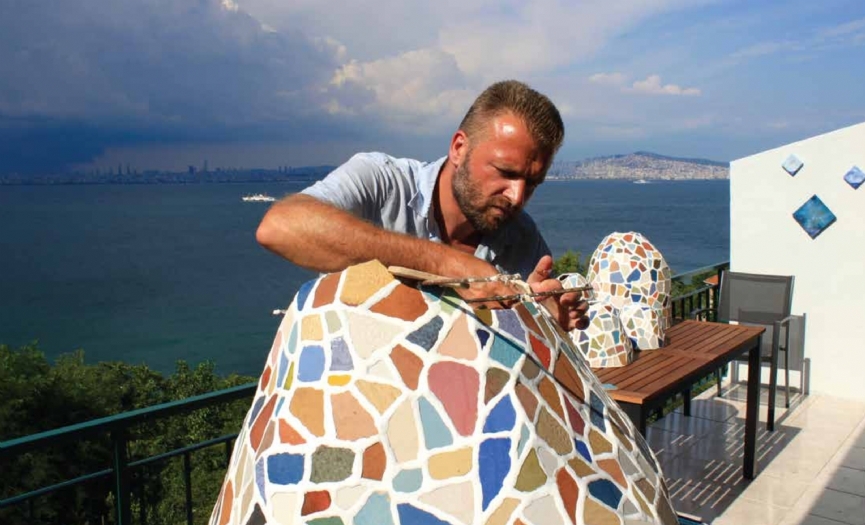
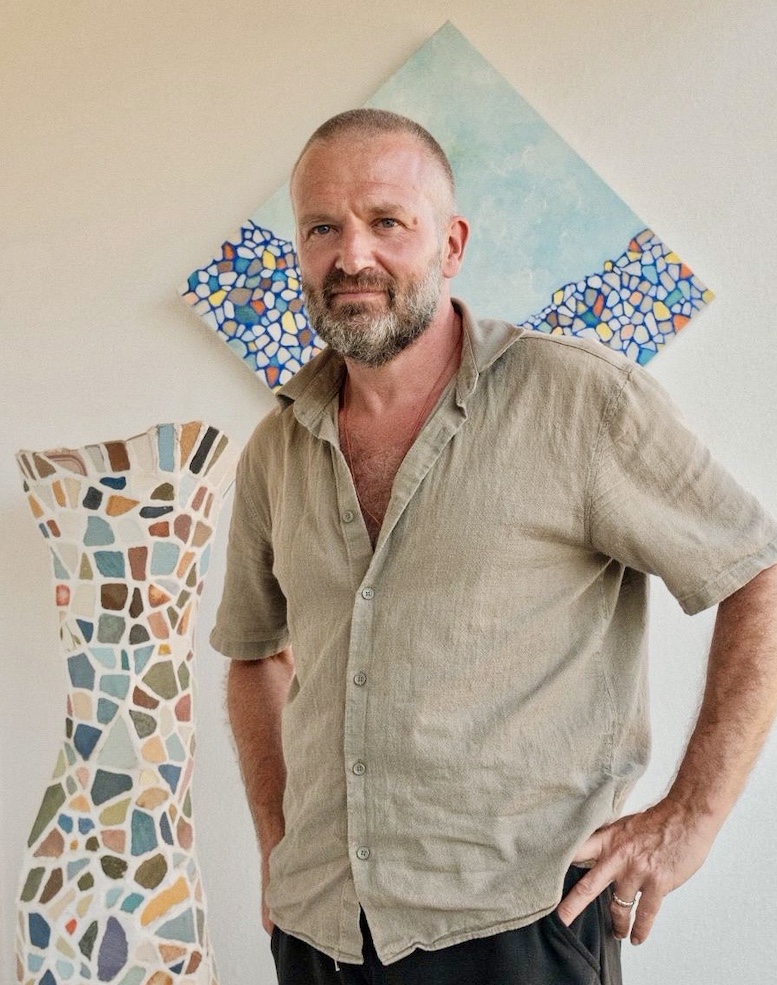
Koenraad Marinus Van Lier, who integrated the architectural design education he received at the Gerrit Rietveld Academy in Amsterdam with photography, painting, and ceramics, has been living and producing art in Burgazada since 2016. Incorporating the island's nature, limestone, and waste materials directly into his art, and even using the island itself as a canvas, Van Lier both documents the island's landscape with his photographs and contributes to the island's lifestyle and culture with projects such as The Burgazada Compost Garden.
Perhaps because I am an islander myself, I was deeply moved by the artist's life on the island -all year round, the deep bond he established with Burgazada, and especially the captivating mosaics brought to life using materials gathered on the island.
Would you please tell our readers about yourself?
I am a Dutch visual artist, born in 1976. I studied Architectural Design at the Gerrit Rietveld Academy in Amsterdam, where photography also became an important part of my artistic practice.
I moved to Istanbul in 2013, and since 2016 I have been living and working on Burgazada. Over the years, my work has developed from cultural productions and digital art into painting, ceramics, mosaics, and working with natural and discarded materials such as limestone.
Living on the island has had a profound influence on my work. I work directly with materials that come from the island; I have even used the island itself as a canvas, while documenting its landscape through photography. More recently, my involvement with projects such as FITO Antigoni, which maintains the Burgazada Compost Garden and the Health Garden, has also become an important part of my life here.
Burgazada has gradually become not only the place where I live, but also an important part of what I create and how I create it.
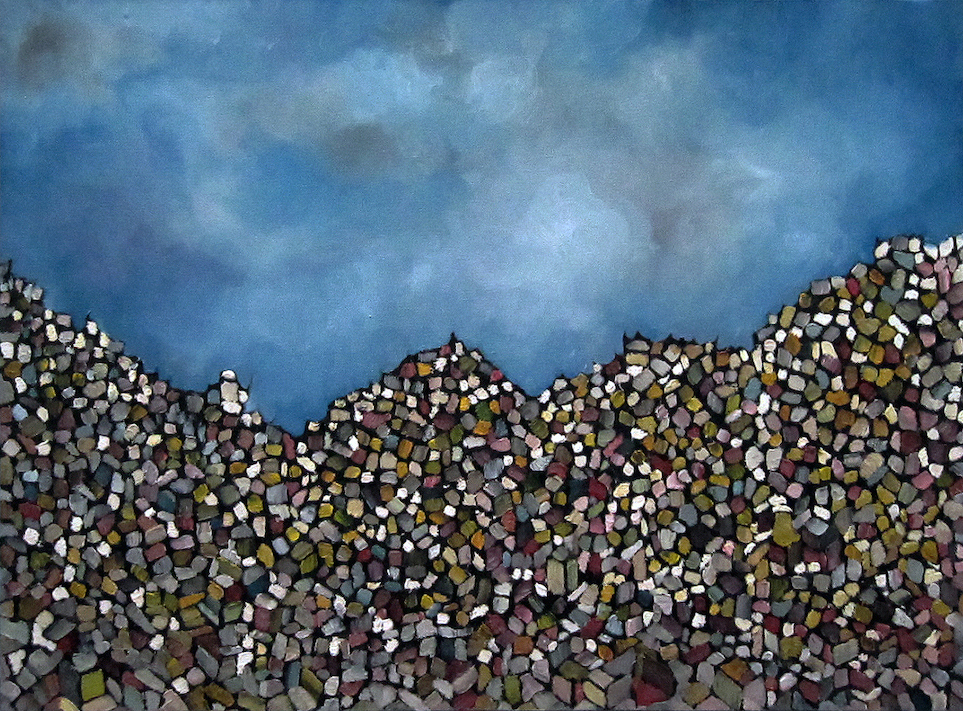
Istanbul, oil painting by Koenraad Marinus Van Lier
What initially drew you from the Netherlands to Istanbul, and even furthermore, specifically what made you choose Burgazada as your permanent home?
I first came to Istanbul in 2010, when the city was European Capital of Culture, as part of an exchange project. That first experience made a strong impression on me. I was fascinated by the city’s complexity and contradictions.
When I moved to Istanbul in 2013, I was also at a turning point in my artistic practice. I had been working mainly with digital art and wanted to return to painting and to working with physical materials. I started making what I think of as “mosaic-like” oil paintings, constructing images from many small painted fragments rather than working in a traditional painterly way.
At the same time, I started to see Istanbul itself almost as a mosaic. Especially when you look at the city from above, or from a certain distance, you see all these different pieces, colours, structures and layers coming together to form one enormous image. That way of looking at the city also influenced how I thought about painting.
At the time, I was living in a small apartment in Elmadağ and painting outside on the roof terrace, because oil paint dries slowly and needs good ventilation. Then construction started directly in front of my door. The noise, dust, and dirt made it increasingly difficult to paint, and the dust would settle on the wet paintings.
Later I moved to Erenköy, where I met my wife by the seaside. But there too, construction seemed to be happening almost everywhere. We started thinking that perhaps we should live somewhere where construction was banned, and that led us to look at the Princes’ Islands.
We fell in love with Burgazada. Luckily, we were able to find an affordable place to rent on the back side of the island, in the Aya Nikola neighbourhood. In retrospect, the move was partly a practical decision, but it also opened up a completely different way of living and working for me. The island gave me the space and environment I had been looking for, and it gradually became much more than simply a place to escape the construction of the city.
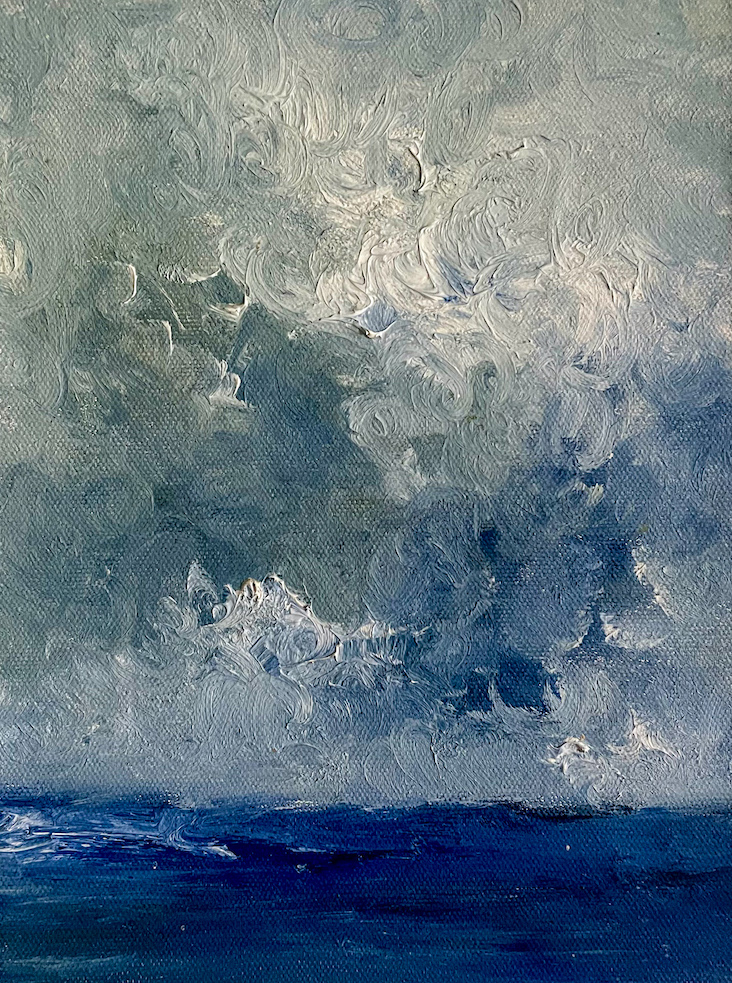
Sea and Clouds, oil painting by Koenraad Marinus Van Lier
You studied architectural design, then moved to photography and film development, started your art life with digital arts where you used your computer probably as a pencil, continued with handmade oil paintings, and nowadays you work with clay ceramic tiles, mosaics, earthworks and limestone instead of pixels and computer. How did all this transition happen?
I don't really see it as a series of separate transitions. Looking back, there has always been a connection between the different things I have done. What has changed is the material I use and my relationship with it.
My architectural education gave me an interest in structure, composition, space, and the way different elements come together. Photography taught me to look closely at the world and to think about how an image can capture a particular moment or perspective.
For a long time I worked digitally. The computer was almost like a pencil for me, a tool for constructing images. But after years of working with digital media, I felt a strong desire to return to something more physical. I wanted to make things with my hands again. That was when I started making the mosaic like oil paintings, building images out of many small painted fragments.
There is also something about working analogue that became increasingly important to me. With pixels and vectors and nowadays AI, you can reproduce an image perfectly and endlessly. With analogue work, every piece is slightly different and becomes a one-of-a-kind object. The hand, the material, and the process leave their traces. I find that uniqueness very valuable in a time when so much of what we see and produce can be copied infinitely.
When we moved to Burgazada, something else happened. I started spending a lot of time at the beach, and I became increasingly aware of how much construction waste and other discarded material was ending up in the landscape. There were pieces of marble, ceramic, stone, and all kinds of materials that had been thrown away. Instead of seeing them simply as rubbish, I started looking at them as potential materials.
That was an important turning point for me. I became much more environmentally aware, and I started collecting found materials and incorporating them into my work. The landscape was no longer just something I was photographing or representing; it became a source of the materials themselves.
I became increasingly interested in working with materials that already have a history and a physical presence.
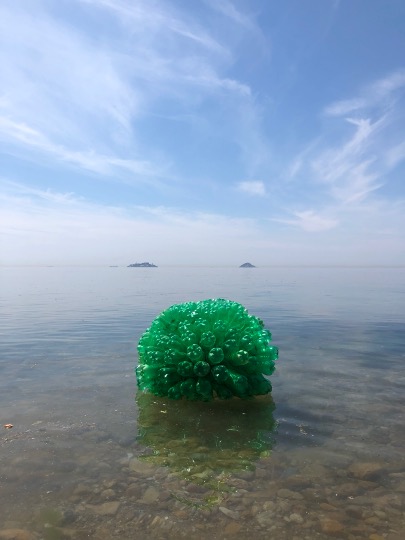
Floating Bottle Installation by Koenraad Marinus Van Lier
You had an environmental beach garden project using discarded materials and limestone from Madam Martha Bay. What story were you trying to tell about the relationship between human waste and nature?
After we moved to Burgazada, I started spending a lot of time at Madam Martha Bay. I had always been interested in nature, but seeing the condition of the beach made me much more environmentally aware. The beach was heavily polluted with plastic and years of construction waste that had been dumped into the sea and washed ashore.
At first, I simply started cleaning the beach. But while collecting all this material, I began thinking about what I could do with it rather than simply removing it. That was how the idea for the Beach Garden developed.
For me, the most important part of the project is the idea of growing something. Pollution is essentially the opposite of growth. When we pollute, we take something living and make it less capable of supporting life. A garden does the opposite: it creates the conditions for life. Plants grow, flowers appear, insects arrive, seeds are produced. There is a cycle of regeneration.
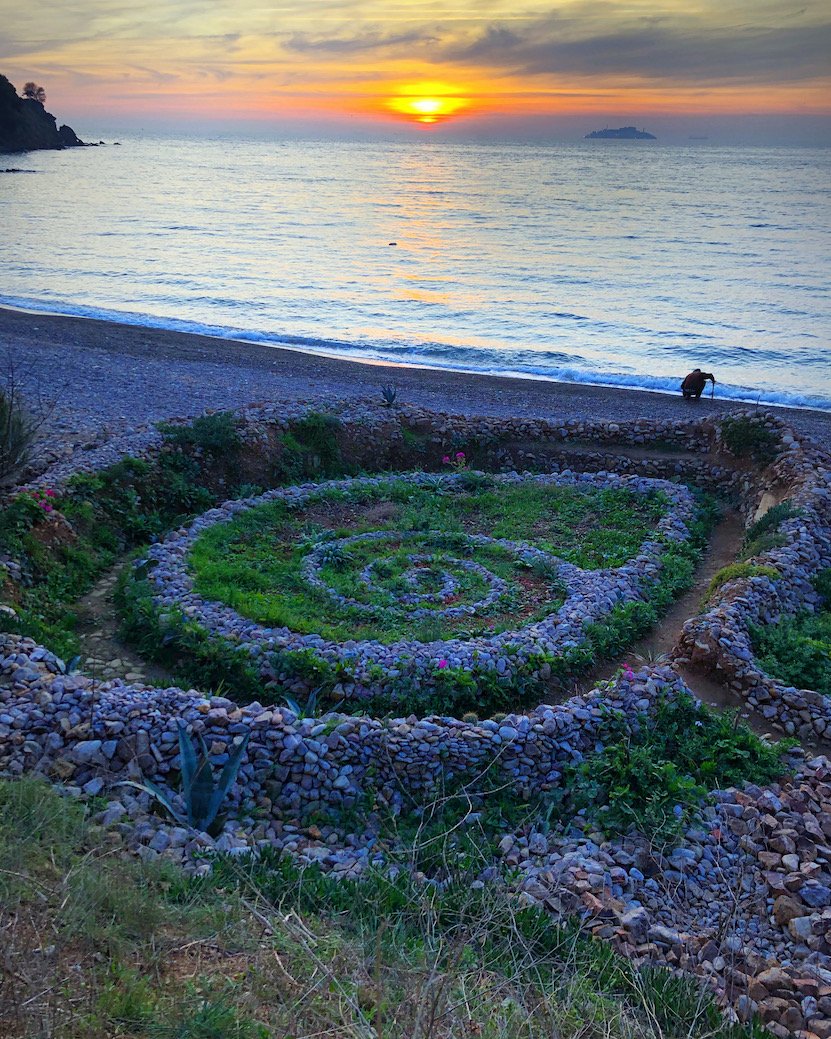
The Beach Garden (2019) - Madam Martha Bay
That is also why the garden has a strong metaphorical meaning for me. The garden is one of the oldest images in art and culture, and perhaps the most famous is the Garden of Eden. It represents an original state in which human beings are still part of nature rather than separated from it.
So I was interested in making a garden in a place that had been damaged by human activity, to take a polluted landscape and give it back the possibility of growing.
The Beach Garden is therefore both an environmental project and a work of art. I see it as a kind of living sculpture, but unlike a conventional sculpture, it is never finished. It changes with the seasons, grows, dies back, and grows again. Its meaning is in that process.
Eventually, the garden may disappear entirely as sea levels rise. In that sense, it is also a temporary gesture, a small attempt to give something back to nature while knowing that nature itself is changing, partly because of what we have done to it.
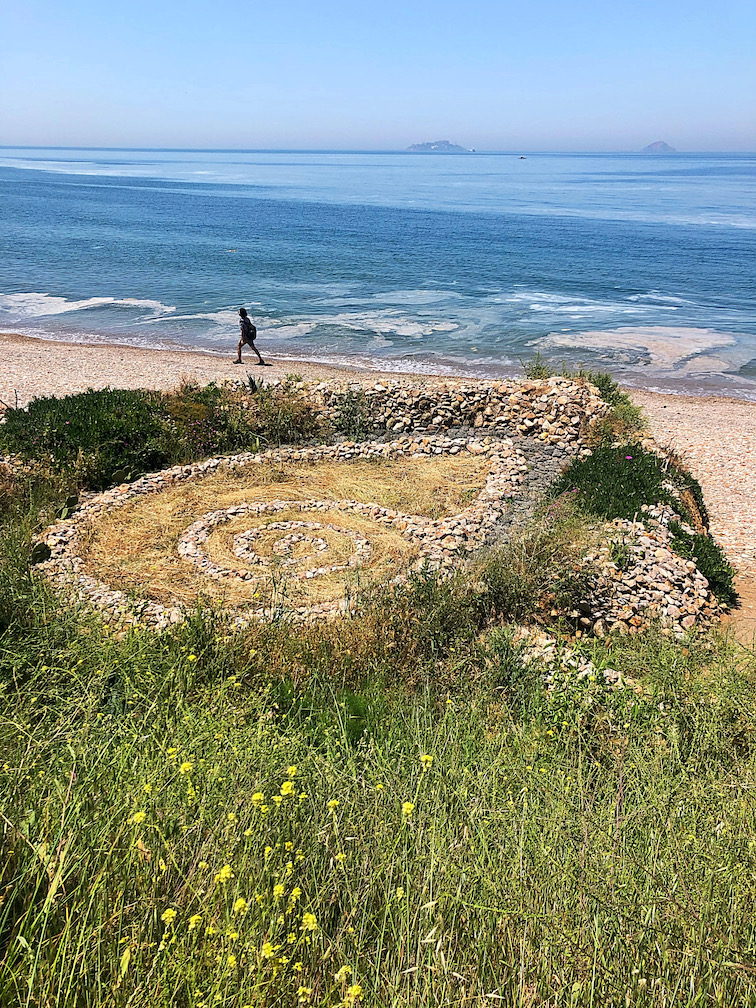
The Beach Garden (2021) - Madam Martha Bay
I am an islander, but only during the summers; you are a foreigner living on the island the whole year. Islands have very distinct seasonal personalities. How do you approach capturing the vibrant, crowded summer energy versus the quiet, isolated winter months on Burgazada? And even further, how does the island of Burgazada shape your daily creative routine compared to a bustling metropolis like Amsterdam or central Istanbul?
For me, Burgazada is almost a different place in every season. In summer, the island becomes incredibly lively. The population increases enormously, the beaches are full, and the streets become places for people to meet.
But for me, summer also means losing access to the parts of the island I love most. The forest and the hill where I spend a lot of time during the rest of the year, but during the summer months they are forbidden to access because of the enormous risk of wildfires. The summers are becoming drier every year, and the combination of heat, dryness, and the large number of people on the island makes the fire risk a serious concern. The beaches are occupied by rows of sun loungers, and there is also a huge increase in littering. You become much more aware of the pressure that such a large seasonal population puts on the island.
Then autumn arrives and with it finally comes the rain. After the long, dry summer, the first rains are almost a relief. The landscape changes again, the risk of fire decreases, and the forest and hill become accessible again. The island slowly empties and winter brings an entirely different character.
The winter lodos storms can be quite extreme. The island becomes wilder, and the sea dictates the rhythm of life. Sometimes the ferries are cancelled, and you simply cannot leave the island. You are reminded that, despite all our technology and infrastructure, we are still dependent on the weather and the natural elements.
But the storms also bring something with them. The strong southwesterly winds and waves bring new materials onto the beaches: driftwood, stones, pieces of tiles, and all kinds of things from the sea. For me, this also makes winter a time for collecting. You never quite know what the sea is going to bring, and some of these materials eventually find their way into my work.
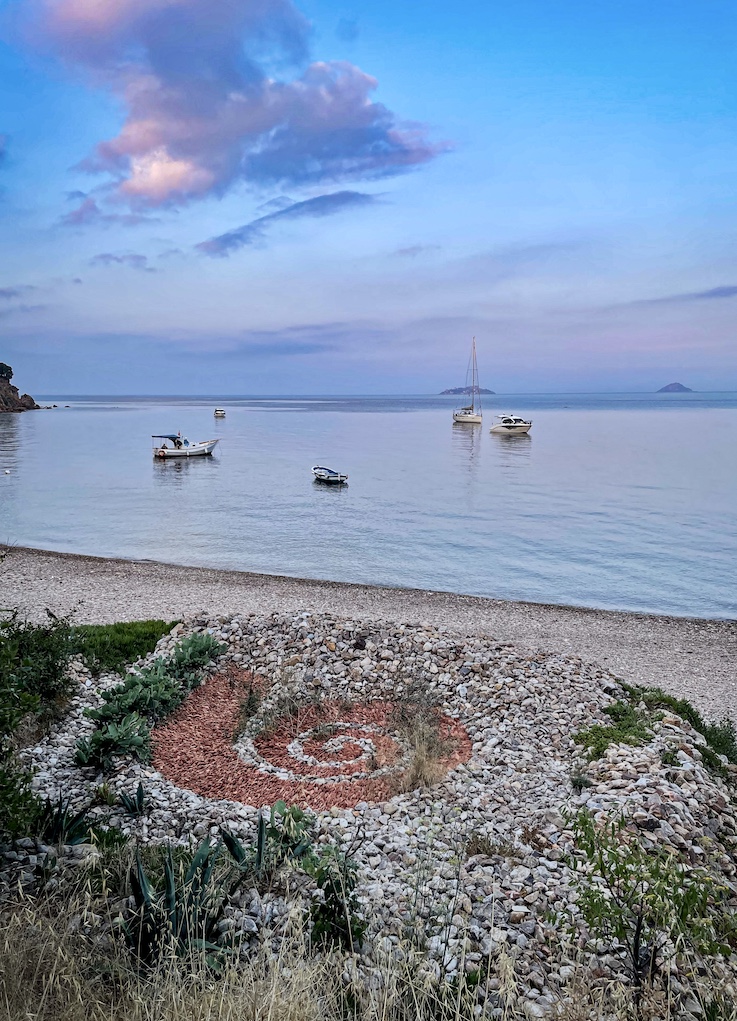
The Beach Garden (2025) - Madam Martha Bay
I also swim all year round. In fact, I prefer the colder temperatures of the sea. Winter swimming gives me a completely different relationship with the island and the sea. When the water is cold and the weather is rough, you really feel the elements rather than simply looking at them. It is another way of being physically connected to the place throughout the year.
Then spring arrives, and the island starts blooming again. After the rain and storms of winter, everything suddenly becomes green and full of flowers. The hills and forest come alive, and there is an incredible feeling of renewal. For me, spring is probably the most beautiful time of the year on the island because you can literally see nature beginning again.
That is perhaps the biggest difference from living in Amsterdam or central Istanbul. In a city, you often have to make a conscious effort to get into nature. On Burgazada, nature is part of your everyday life. It is outside your door, and sometimes it determines what you do that day.
I think that has changed me as an artist. I have become more patient and humble.
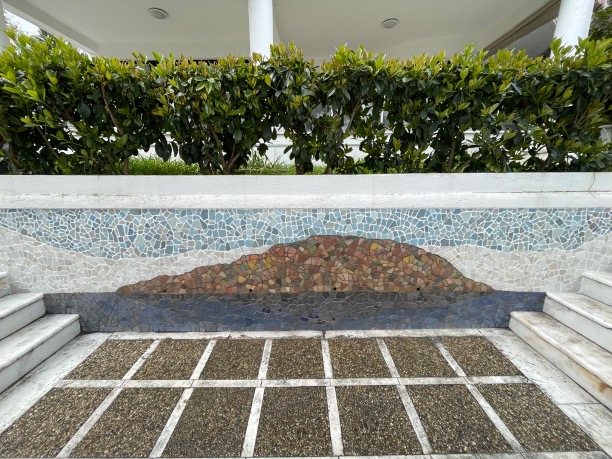
Wall mosaic
How has the local island community received your work? You came here as a foreigner but became a part of the island. I know you have done a couple of commissioned works for some of your neighbors. How did these connections develop?
When I first moved to Burgazada, I didn't come with the intention of becoming part of the community. I simply came here to live and work. But when you live somewhere for many years, especially on an island, you naturally become part of the everyday life around you.
Photography was also a way of connecting with the community. I regularly shared photographs of the island in the Burgazada Facebook group and on Instagram.
The Beach Garden also brought me into contact with many people. I spent a lot of time working there, collecting waste, cleaning the beach, and gradually building the garden. People would stop and ask what I was doing, become curious, or simply start talking to me. I met so many people through that project, it created opportunities to interact with people I might otherwise never have met.
Every year I also opened my studio to the public, giving people the opportunity to come in and see what I had been working on. These studio visits became an important way for people to discover my work and to see the process behind it. It was often through these visits that the commissioned works came about. Someone would see a piece in the atelier, we would talk about it, and eventually they might ask me to make something specifically for their island house.
My involvement with FITO Antigoni has also strengthened this sense of community. Working together on the compost garden and Health Garden is very different from making an artwork alone in my studio. You are working alongside other people, doing something practical for the island. You get to know people through doing things together.
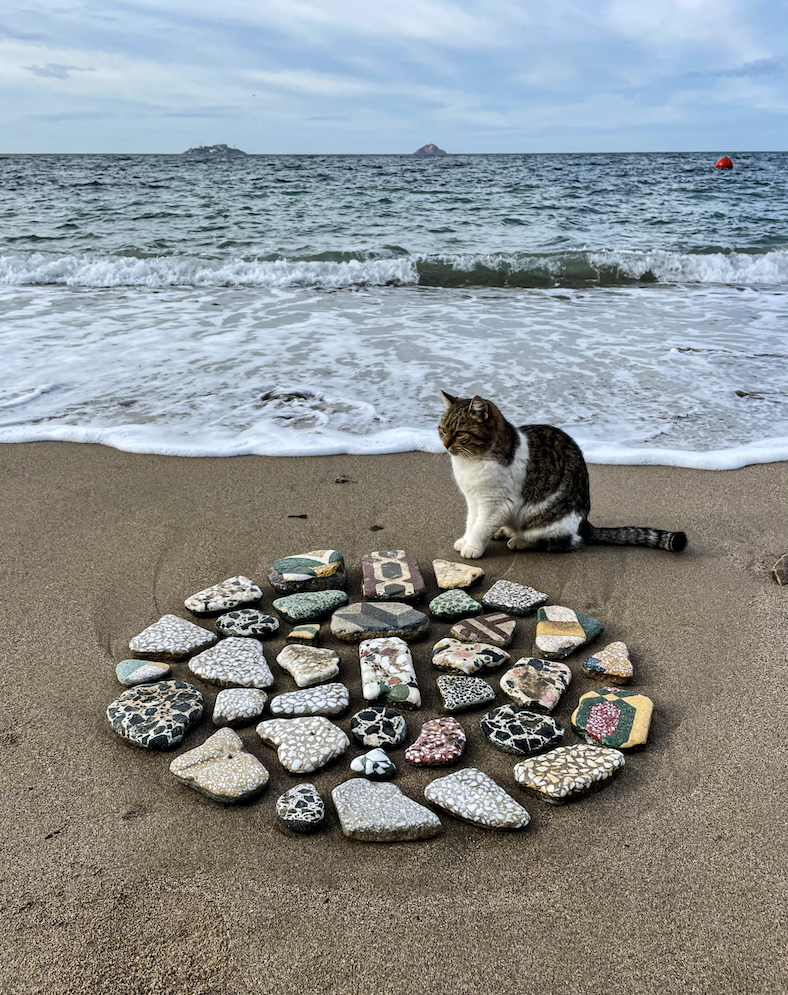
Terrazo
I have been to your atelier and seen your mosaic work and am truly attracted to your art. Please tell us about your mosaic works how it differs then a common mosaic art piece.
My mosaic sculptures developed from my fascination with the broken ceramic tiles and pieces of beach glass that I found on the beaches of Burgazada, particularly at Madam Martha Bay. I don't break the tiles myself. They have already been broken, often by construction, time, and the sea. The sea continues to shape them, washing them and eventually bringing them back onto the beach, where I collect them.
I use a technique related to trencadis, which traditionally means making mosaics from broken or discarded pieces of ceramic and tiles. But I use it in a rather different way. In a conventional mosaic, the pieces are usually glued onto a surface to create a two-dimensional image or decoration. In my sculptures, the pieces themselves become the construction. I use silicone to connect them, while the inside remains empty. So there is no separate structure underneath; the decoration is also the structure.
I build the sculptures piece by piece, almost like assembling a large three-dimensional puzzle. I don't have a completely predetermined form in mind. The shape develops through the fragments themselves. Their irregular shapes and colours influence where they can go.
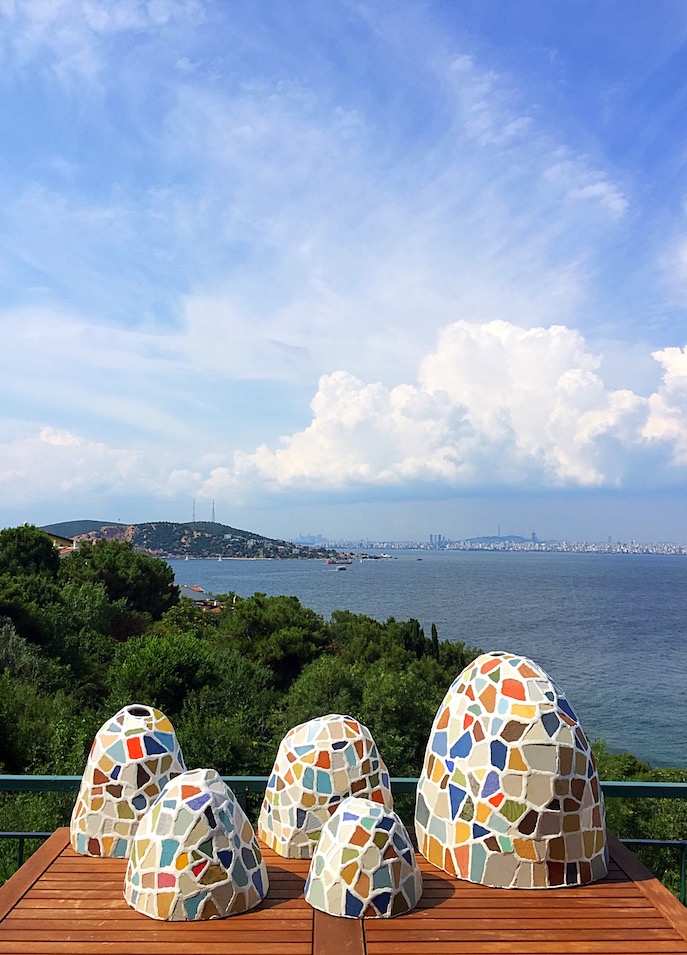
This makes the process quite different from working with newly produced, uniform mosaic tiles. I am not trying to make all the pieces conform to my design. I try to work with what I find and allow the material to have a certain amount of control over the final form.
The sculptures often become organic, almost geological shapes. They can look as though they have grown rather than been constructed.
There is also an environmental aspect that is very important to me. These tiles were once part of people's homes. Many of them are from older buildings and date from the 1950s, 60s, 70s, and 80s. At some point, they were treated as waste and ended up in the sea. But throwing something into the sea doesn't mean it disappears. Ceramic can remain there for an incredibly long time; the sea simply continues to break it down and move it around.
By collecting these fragments, I am cleaning the beach, but I am also giving something that was considered waste a new life. Instead of hiding or disguising its history, I want the history of the material to remain visible.
So for me, the mosaic is not only a technique for making an image. It is a way of bringing fragments back together physically, but also symbolically. Something that was broken and discarded can become whole again in a completely different form.
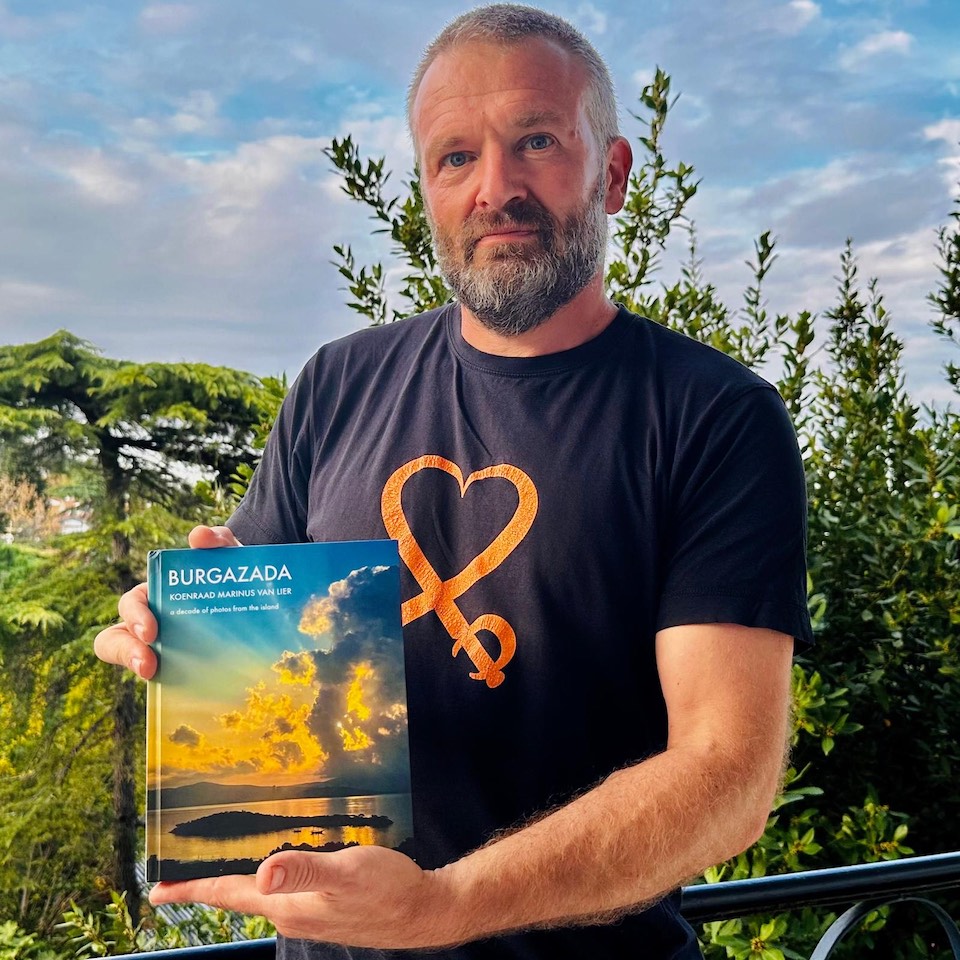
You have a book named "Burgazada: A Decade of Photos from the Island," a prominent photography book and exhibition documenting over ten years of island life, changing seasons, landscapes, and community dynamics. Please tell us about it.
I never initially planned to make a book. I was simply photographing what I encountered: the landscapes and changing light.
When I was reaching ten years on Burgazada, I wanted to mark that period in a meaningful way. The idea for the book became quite simple: 120 months, 120 photographs, one photograph for each month I had lived on the island.
That structure makes the book about time as much as it is about place. It isn't simply a collection of my favourite photographs. It follows ten years month by month, and through those images you see the changing seasons and the changing landscape.
There is a short poem I wrote at the end of the book that perhaps explains better than anything else what the photographs mean to me:
to live on the island
is to live in a painting
for ten years I’ve lived
on this magical place
photographing its light
seasons and quiet moments
these frozen fragments in time
portray the island through my eyes
trying to capture its majesty
and silent visual poetry
hoping they serve as an invitation
to pause for a bit and look again
I think that describes my experience very well. When you live here, the landscape is not something you occasionally visit; it becomes the environment of your everyday life.
We become accustomed to the places we live in. We see the same sea, the same trees, the same streets every day and can stop noticing them. Photography gives me a reason to look again.
The book was also important to me because I wanted to make it independently. There is no publisher or sponsor behind it. I produced and published it myself, and the printing was made possible through pre-orders from people who believed in the project and wanted to see the book come into existence.
It also meant that I could make the book in my own way, without having to adapt it to commercial expectations. It remains a personal document of the island and of those ten years.
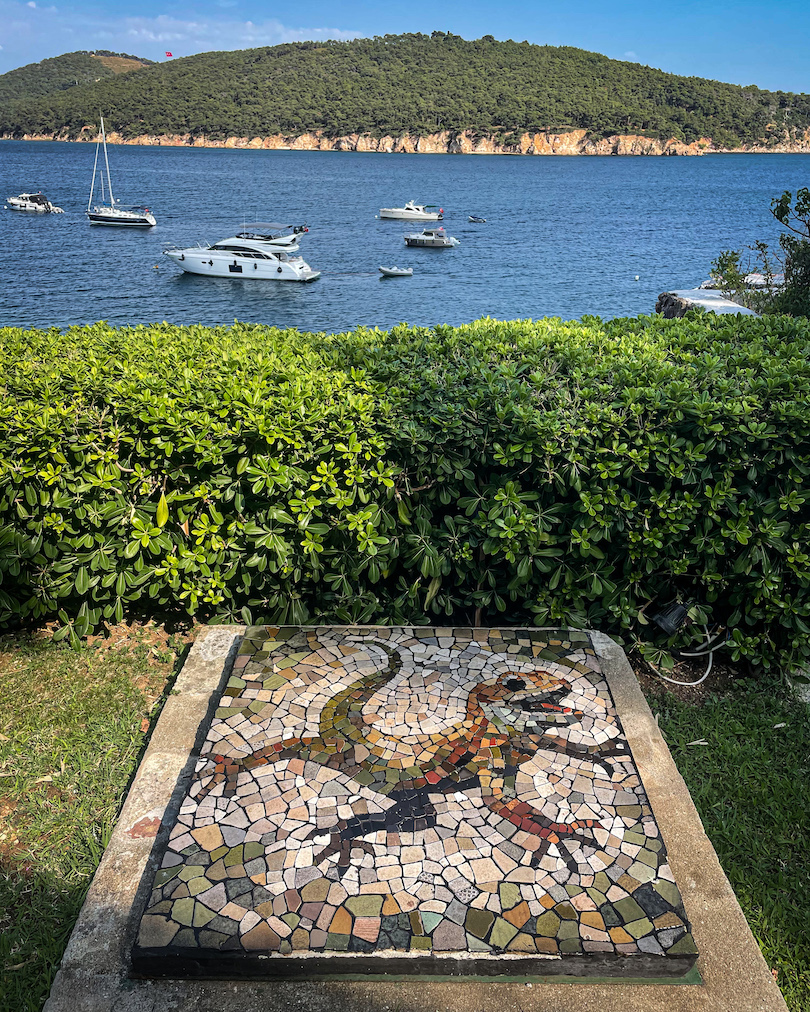
Garden mosaic - Koenraad Marinus Van Lier
Ten years is a powerful milestone. Do you feel your artistic future will remain permanently anchored to the landscape of the Princes' Islands, or are there new, uncharted geographies you are starting to look toward?
I think Burgazada will always remain an important anchor in my artistic life. Ten years is a long time, and the island has become deeply connected to the way I see, work, and live. It is not simply a subject for me anymore. It is part of my everyday environment, and many of the materials, ideas, and questions in my work come directly from living here.
But I also know that this relationship may not last forever. The island is changing, with increasing urbanisation and overtourism, and one of the things that worries me most is the possibility of construction eventually reaching the island. If construction comes to the island on a large scale, I think I will have to leave again. I don't want to stay and witness the destruction of the trees and the landscape that made me want to live here in the first place.
That is perhaps also why I feel a certain urgency about documenting the island now.
At the same time, I don't think leaving Burgazada would mean leaving it behind. The island has taught me to pay attention to what is already around me, to collect, observe, wait, and work with what a place gives you. That could be a piece of stone, a broken tile, a landscape, a particular kind of light, or simply something that has been overlooked.
So I don't see my future as a choice between staying on Burgazada forever or leaving it behind. Burgazada is the place that has shaped my way of looking, and I think that will remain with me wherever I go.
In one of your interviews, I read about your grandfather who never had time to see the sea. Do you believe our family histories or our names quietly guide the big choices we make in life without us realizing it?
I don't know if our family histories determine the choices we make, but I do believe they can leave something behind in us that we carry without always being aware of it.
The story of my grandfather is a good example. His name was Marinus, which comes from Latin and means “of the sea”. I was given Marinus as my second name, after him. And yet, despite having a name connected to the sea, he simply never had the time to see it.
There is something quite poetic about that coincidence when I look at my own life. I have chosen to live on an island beside the sea. I photograph it, swim in it, collect things that it brings onto the shore, and increasingly make work from materials shaped by the sea. I don't know if there is a direct connection between my grandfather's story and the choices I have made, but I find it difficult not to see some kind of thread running through it.
We make choices because they feel right to us, and only later do we sometimes look back and realise that there were things in our family history, or in our names, that had been quietly pointing in the same direction.