15 October
Two First-Place Prizes for Carmen Dilara Bağış in Minerbio 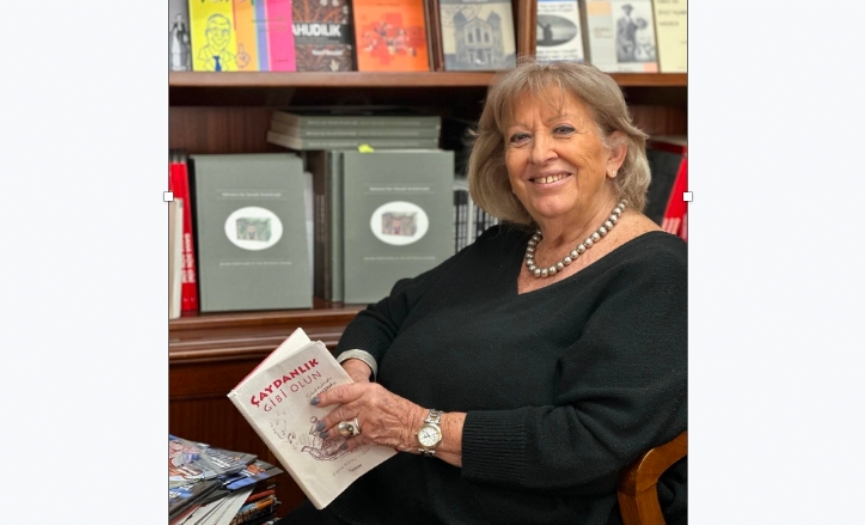
"What a difficult task it is to be uprooted! What a wound it is that bleeds silently for a lifetime. It's a great battle. Is it easy to decide to migrate?" With these words, she captured the phenomenon of migration, and later, with the sentence, "I and my generation were molded in the soup of wisdom inherited from forty nations that made Istanbul what it is," she explains that integrating into society does not mean losing one's sense of belonging; I met a writer who wrote with her heart: "Elena Kovaçi Uygan."
A book that makes you smile, laugh out loud, feel sad, and think
At the point of frozen that modern humanity has reached, this book warmed both my eyes and my soul: "Be Like a Teapot, From Thessaloniki Villages to Burgaz Island."
The author's captivating sentences, which elegantly underscore the enduring humanity of humankind, mesmerize the reader. You witness the perspectives on life, inner worlds, friendships, and the vibrant sounds of Burgaz Island, all part of the minority groups that have laid the foundation stones of Istanbul's urban memory. We spoke with author Elena Kovaçi Uygan about her book, which she describes as "a generation full of adventure, humor, fun, and laughter, a generation that doesn't harbor evil thoughts and sings," and which captivates its readers in a conversational style.

Çaydanlık Gibi Olun, Selanik Köylerinden Burgaz Ada’ya, Elena Kovaçi Uygan, January 2026, First Edition, Gözlem Yayıncılık, 206 Pages, Turkish
While you're living in the present moment and accumulating memories, how do you manage to fit the stories from your bottomless chest into writing?
I've been writing for as long as I can remember. I wrote long letters, completed school assignments and essays, and after I got married, I wrote essays for my nieces, nephews, my son, and the children of friends and relatives. During my student years, encouraged by my teachers, I tried to write a novel, but I couldn't. In my youth, I tried writing love poems, but that didn't work out either. I realized I don't have a talent for fiction. I can only describe my experiences well.
When Facebook opened, I continued this habit there as well. I went on to write about an event that happened during the day, connecting it to one of my own experiences. When my writings started to be read with interest, I wrote more and more. Short pieces. Because people have become reluctant to read long and detailed things. I've tried to add a touch of interest and a little humor to my writing, something to help relieve the stress of everyday life. I often find myself writing alone and suddenly switching to another event that supports or connects to the main topic. I warn the reader so they don't lose focus, and then I return to the main point. I'm also adding a warm, conversational tone to my writing with a village expression my father often used: "Where are you going to tie the donkey?" – meaning "Where are you going to connect the topic?"
In developing your warm and friendly conversational style, was it more influenced by your life experiences or by the character that makes you who you are?
Well, if the experiences I've had shape me and I need others to learn from them, I use that as well. For example, I sometimes end my sentences with "the moral of the story." For example, in one of the stories in my book, I give an example to one of my company employees about how to stand strong against workplace bullying (mobbing). I don't tell my employee to just put up with it, nor do I tell them to rebel. I suggest they imagine themselves looking down from a high vantage point at an ant colony, and find the strength to endure, even feel pity, for the person doing the bullying—who is essentially struggling within their own troubled personality, just like those ants in that struggle. Some of it is a result of my character, for example, I am very patient; some is something I've learned from a book I've read, an article, or the words of a wise person; some is from my life experiences. But my language is always sincere, conversational, because I always want to touch the soul of the person I'm speaking to!
While it's easy to express nostalgia for the past in writing, to compare it to the present, and to leave "nostalgia" as merely a reality, you are also bidding farewell to the people, events, cities, countries, and places in your memories that give life to your book, lovingly closing the file and moving on. As a Bibliojournalist, I believe that the most striking element of a writer for the reader is "the fluidity of their writing." We don't read your book; we listen with pleasure to what you tell us. We flow along with what you write. So, how do you flow with life and your memories while writing? How do these memories, which you keep on the shelves of your soul, flow onto your pen?
The feedback I get from my readers says the same thing! As a child, I constantly listened to my mother, my grandmother, and their pasts. (I'm going to skip ahead again here), for example, my mother was relatively open-minded. To us girls who rebelled against the rules, she would always say: "My doughter, life is short, I want you to live it to the fullest more than anyone, but what will people say?" I grew up, lived through my own past, experienced limitations, shaped my relationships, and witnessed the new economic and political future with our children, the struggles of the new generation, but I always looked at things comparatively. I've never had any regrets, or at least I haven't dwelled on them too much. Because of that, an incident on the road, a conversation with a driver, a mishap... all become fodder for my Facebook post that evening, and it just flows!
Why has the phrase "Be like a teapot" been a focal point of your interest, both in life and in writing?
Since my youth, whenever I came across an interesting saying, phrase, philosophy, or poem, I had a notebook where I wrote it down, and I still keep it. This anonymous saying resonated so strongly with my mother's teaching—which I also discuss in my book—that "no matter what happens, there's no remedy for what's already happened; move on and look ahead." And it perfectly mirrored the turbulent period of our lives, the series of events we experienced one after another… In short, this phrase became not just my focus of interest, but the center of my life. To give an example, as a family, we didn't tell my father, who was already ailing, about our pain and helplessness following my husband's death and my brother-in-law's illness, so as not to burden him with it. We lost my husband on December 23rd, celebrated Christmas on December 25th, and New Year's on December 31st, all together as if nothing had happened, putting on a show. As you can see, we've become, and continue to be, a complete teapot with every problem!
You are a soul and a pen that embraces the experiences life, the teacher, offers with open-mindedness and love. Keep writing as you live, and tell us about your experiences through your new books; we will listen as we read. I offer you a heartfelt "biblio thank you."
Thank you for giving me this opportunity and for your appreciation.