15 October
Two First-Place Prizes for Carmen Dilara Bağış in Minerbio 
Elizabeth Graver's novel 'Kantika', inspired by her grandmother Rebecca (née Cohen Baruch Levy), who was born into a Sephardic Jewish family in Istanbul and was a colorful traveler in her long and turbulent life, has been translated into Turkish. My article titled "The History of a Sephardic Family That Became 'History'" was published in the Şalom Newspaper on June 7, 2023. In our interview published in the Şalom Newspaper on December 27, 2023, I asked author Elizabeth Graver when her novel Kantika would come to life with Turkish words. Author Graver responded, “The Turkish edition will be published by Everest Publications. I have signed the contract, but I don't yet know the details about the publication date or the translator.” Almost three years later, the Turkish edition of Kantika was published by Everest Publications. The book was translated into Turkish by Seda Çıngay Mellor. The Turkish text consists of 376 pages. We spoke with author Elizabeth Graver about the Turkish translation of Kantika.
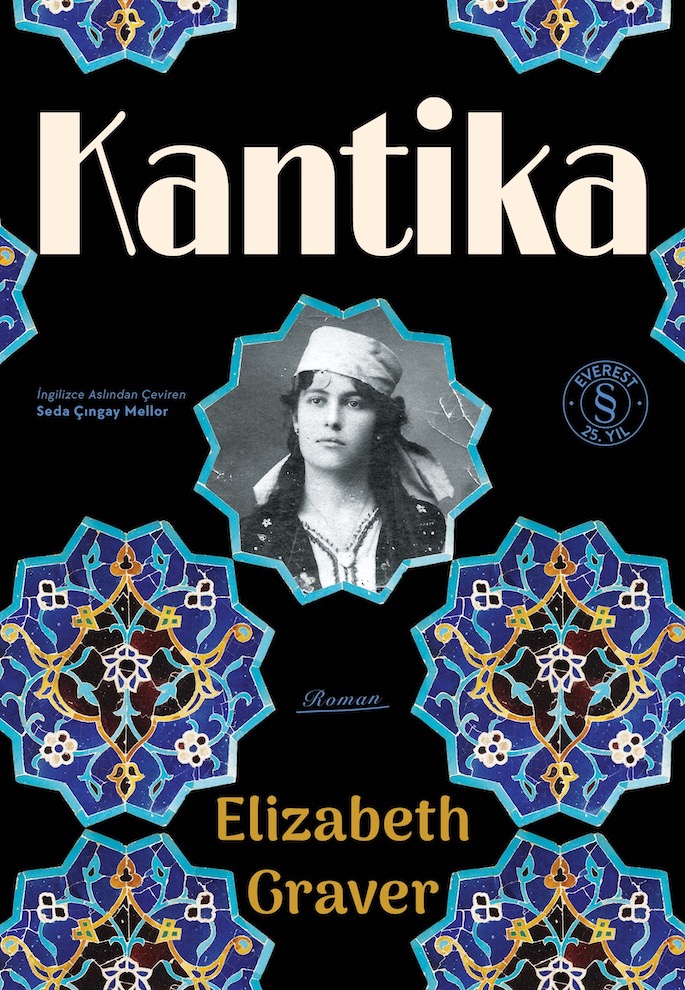
Kantika - the cover of the Turkish edition
During the translation process of your novel Kantika into Turkish, did you undertake any additional work for the novel? What was your communication like with the translator?
The translator, Seda Çıngay Mellor, is extremely skilled and experienced, and I feel lucky that the press chose her as the translator. She caught a few inconsistencies around dates and cultural details. As one example, I had the characters drinking apple tea—it was offered to me many times when I travelled in Turkey—but the translator informed me that this is largely something given to tourists and not true to the context of my novel. As a result of her meticulous reading, I made some corrections, both for the Turkish edition and for the English language e-book and future print editions.
What does it mean to you that Kantika has been translated into Turkish?
Both personally—because Turkey is where my maternal grandparents, who inspired Kantika, were born and raised—and culturally and historically, since it was an important home for Sephardic Jews after they were expelled from Spain, I'm thrilled to have this story available in Turkish. My grandparents had deep roots in Turkey and loved it there; they were quite heartbroken to have to leave. In a broader way, history is quick to disappear, especially as nations and their populations change over years and decades. To remind people of this slice of history at the start of the 20th century feels important.
The fact that there was a long period of cohabitation and rich cross-pollination between Jews, Muslims, and Christians in the former Ottoman Empire also feels like a vital reminder in our current times. Rebecca in the novel (she is the central character, inspired by my grandmother) attended a Catholic school as a young Jewish girl; her classmates were Christian, Jewish, and Muslim. She was educated in French but spoke many languages and had a wide appreciation for the worlds—whether linguistic, cultural or religious—that existed beyond the ones she encountered in her home. This is not to ignore the difficulties of that era—there were plenty, for various populations—but there was also a lot of flow and common ground.
How do you think the time periods set in Turkey in your novel will affect readers of the Turkish language?
I hope some readers will feel a spark of recognition and connection in terms of their own family stories. Others may learn something new!
As the author of Kantika, do you think there are any specific points that Turkish readers should pay attention to when reading your novel?
Readers will bring their own lenses; I hope the story resonates with them. For those who live in Istanbul or visit it, I'd love it if they could feel some of the layers of history that my book excavates when they walk the streets in Fener-Balat, where the first part of my novel takes place.
As a critic who read and reviewed your novel Kantika in its original English, I am eagerly awaiting the opportunity to read the Turkish translation. I wonder if I will be able to capture the same emotions in the Turkish sentences that I felt in the English version. I will write a separate critique for this purpose. My final question is: Do you have any concerns about the loss of meaning and emotion in the translation of your novel into other languages, including Turkish?
Thank you for the conversation we had about the English version, Neşe! Any translation will have its own voice, and things will surely be lost; it's in the nature of the beast. But a gifted translator is able to capture the essence. Musicality—the cadence of words, their sounds, their poetry—is very important to me, so I hope that comes through in the Turkish translation. Unfortunately, I don't speak Turkish, so I can't judge for myself, but I trust this translator. There may even be new things she was able to evoke since each language has its own particular gifts.