18 September
Gamze Terra and A Warm Gaze 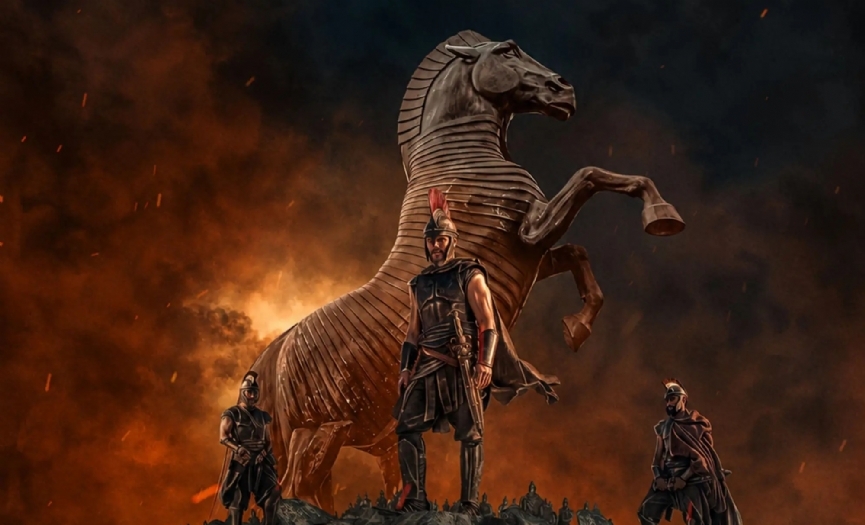
Sometimes a film director comes along who, with extraordinary courage, undertakes something truly monumental. He spends hundreds of millions of dollars making a film and chooses a subject so profound that, in a postmodern world that has effectively shrunk into a small village, everyone—from philosophers and filmmakers to artists, writers, intellectuals, politicians, and, of course, ordinary moviegoers—spends days, even weeks, debating the central question of the film from the perspective of their own world.
Very few directors have been able to achieve this. At the forefront of them stands Christopher Nolan. With his 2023 film Oppenheimer, Nolan had a profound impact on the world of ideas, and for three years everyone waited for his next film.
This time, Nolan turned to the Odyssey, regarded as the second-oldest foundational text of Western literature. In doing so, he did more than simply offer a new film: he brought the epic itself, its hero, and its philosophical dimensions back into the center of global attention. As soon as the film was released, countless articles, debates, and commentaries on the Odyssey began to appear.
Written by Homer in the eighth century BCE, the Odyssey is a great epic poem consisting of 24 books. It tells the story of Odysseus, King of Ithaca, and his return home after the Trojan War, which lasted ten years, as well as the further ten years of hardship he endures on his journey back.
In the simplest terms, the Odyssey is an epic of homecoming, or nostos.
The Greek armies fight for ten full years to capture Troy. In the end, they achieve victory through Odysseus's extraordinary intelligence and what has become history's most famous military deception. Yet the real epic begins when the war is over: the journey home.
In fact, the Odyssey is a magnificent narrative of the passage from chaos to order. It is a journey from war to peace, from hatred to love, from catastrophe to tranquility. In other words, it is the story of humanity's struggle to transform the entropy created by chaos back into order through a monumental effort.
Odysseus brings about the fall of Troy by hiding his soldiers inside the enormous Trojan Horse he has had constructed. Troy is burned, destroyed, and plundered; much of its population is slaughtered. Following the great victory, Odysseus sets sail with his companions to return to his wife Penelope, from whom he has been separated for ten years, and to his homeland of Ithaca.
But because of his arrogance, he angers the Sea God Poseidon. Poseidon fills his journey home with seemingly endless disasters. As though reminding him of the inevitable hardships of human existence, he places one obstacle after another in Odysseus's path. His purpose is not merely revenge; it is also to make Odysseus forget his home, his family, and the meaning of his life.
Odysseus loses almost all of his companions. His ship is destroyed, and he eventually finds himself half-dead on the island where the famous sea nymph Calypso lives. Calypso, renowned for her beauty, falls in love with him and keeps him on the island for seven years. She offers him every comfort and remains constantly by his side and having sex with him every night. Yet despite all of Poseidon's and Calypso's efforts to make him forget, Odysseus's mind remains fixed on Ithaca.
Eventually, Zeus intervenes and orders Calypso to release him. Though she does not want to let him go, she cannot disobey the command. Before he leaves, she makes Odysseus one final offer:
"If you stay with me, I will give you immortality and eternal youth."
Odysseus does not hesitate for even a moment:
"No."
And once again, he sets out for Ithaca.
According to the contemporary French philosopher Luc Ferry, this decision lies at the beginning of one of philosophy's most fundamental questions. Indeed, Ferry argues that the true history of philosophy begins with Odysseus's rejection of Calypso.
Because the Odyssey seeks, through its hero, an answer to the question: "What is a good life for mortals?"
According to Ferry, the first condition is for human beings to free themselves from their fears—above all, the fear of death. Fear diminishes us, deprives us of our freedom, and closes the path to wisdom.
Secondly, nostalgia for the past and hope invested in the future become sources of unhappiness insofar as they disconnect us from the present. This idea also resonates with Nietzsche's concept of amor fati: human beings can live well to the extent that they are able to embrace both their fate and the present moment.
Finally, Ferry argues that in ancient Greek thought, when human beings understand themselves as part of the cosmos, even death becomes a natural stage of eternity. In this way, they can overcome the greatest obstacle standing in the way of a good life.
This is precisely what Odysseus does. He leaves his fears behind; without surrendering either to the burden of the past or to the uncertainty of the future, he struggles to reach the place to which he belongs: Ithaca.
In his eyes, a successful and happy mortal life is far more valuable than an immortal life in which one remains forever young but loses its meaning.
Because, the purpose of human existence is not to live forever, but to live well the life we have been given.
xxxxxxxx
Christopher Nolan's film, while largely preserving the epic's narrative structure, reinterprets its philosophical backbone through the intellectual codes of the modern world. What emerges is a different narrative, one that is largely psychological and, at times, contains subtle political undertones.
The film's most striking reinterpretation concerns the Trojan Horse.
For Nolan, the Trojan Horse is not merely a symbol of intelligence and cunning; it is also a symbol of one of the greatest civilizational and moral ruptures in human history. The Greeks present the enormous wooden horse to the Trojans as a symbol of peace and the blessing of Zeus, while in reality turning it into an instrument of profound deception.
As emphasized in Odysseus's confession to his wife in the film, this is not merely a military stratagem; it is also a grave violation of the "Law of Zeus"—xenia.
Moreover, Nolan's Odysseus differs significantly from Homer's hero.
Homer's Odysseus is cunning, proud, resilient, and a epic hero struggling to return home.
Nolan's Odysseus, by contrast, is a modern antihero—or perhaps a flawed hero—who carries the moral burden of war on his shoulders, lives with his trauma, questions his own conscience, and seeks redemption.
Thus, while the epic is built primarily around intelligence, endurance, fate, homecoming, and the search for a "good life," Nolan's film places human psychology, guilt, and the fragility of civilization at its center, using the stories of the epic as its vehicle.
Although this choice transforms the spirit of the epic to a certain extent, it succeeds in adding a new layer—one that speaks directly to the conscience and traumas of modern humanity while also questioning the very foundations of civilization.
In the end, Nolan once again undertakes something truly monumental.
Most importantly, he reminds us once again of the question:
"What is a good life?"
A salute to the sublime union of cinema, literature, and philosophy.