14 September
President Erdoğan Extended Greetings for Rosh Hashanah 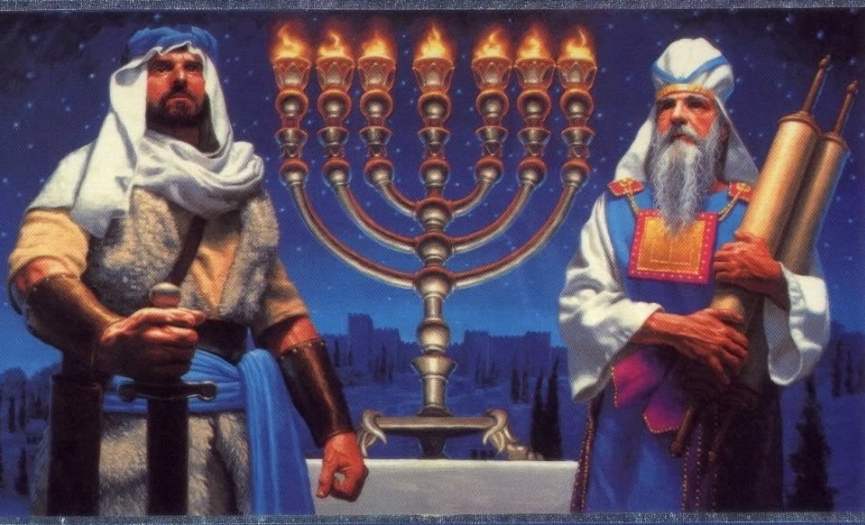
Hanukkah is a word that encompasses the meanings of opening, dedication, and consecration.
Articles dealing with such topics usually assume that the historical background of the event is already known to the reader.
As a result, they tend to focus on details rather than the historical setting and that can be quite demanding for the reader to place the events properly within their context.
For this reason, we will try to present the subject of Hanukkah within the framework of Jerusalem and the Temple of King Solomon.
Historical Background – The Establishment of the Kingdom of Israel
The return of the descendants of Abraham’s grandson Jacob, from their enslavement in Egypt under the leadership of Moses to the “Promised Land” is dated to the 13th century BCE.
Under the command of Joshua, the Israelites crossed the Jordan River to the West and returned to their homeland.
They had to fight to reclaim the territory that had been settled by other peoples during their absence. That land lay between the Jordan River and the Mediterranean Sea and was formerly known as the land of Canaan. They eventually established their sovereignty there.
These Israelite tribes were governed for many years by judges. In order to confront the Philistines—a people of Aegean origin who had invaded the coastal regions (the name derives from the Hebrew verb root PALASH, “to invade,” corresponding to the modern Arabic toponymy Falastīn)—they chose Saul of the tribe of Benjamin as their king (c. 1047 BCE).
It is interesting to note that the long conflict between the Kingdom of Israel and the Philistines resonates in the Qur’an as well:
In Surat al-Baqara, verse 251, which recounts the legend of the young shepherd David :
“By God’s permission they defeated them. And David killed Goliath. God granted David sovereignty and wisdom and taught him whatever He willed. Had God not repelled some people by means of others, the earth would surely have fallen into corruption. But God is full of bounty toward all worlds.”
Jerusalem as Israel’s Capital and the Construction of the Temple of Solomon
This young shepherd, known in Islamic tradition as Prophet David, succeeded Saul and became King of Israel. He conquered Jerusalem (Yerushalayim) and made it his capital around 1010 BCE.
His son, known in Islamic tradition as Prophet Solomon, completed the construction of the Temple of Solomon in 957 BCE. In Hebrew it is called Beit HaMikdash and in Arabic Bayt al-Maqdis.
After Solomon’s death in 931 BCE, the kingdom split into two: the northern Kingdom of Israel and the southern Kingdom of Judah (Yehuda). Those known today as Jews are the descendants of the people who were dispersed after the fall of the Kingdom of Judah.
The northern Kingdom of Israel was destroyed by the Assyrians in 722 BCE, and its population was deported to the region known today as northern Iraq (the Kurdish area), where they eventually assimilated and disappeared.
The Babylonian Conquest and the Destruction of the Jewish State and the Temple
In 587 BCE, the Babylonian king Nebuchadnezzar conquered the Kingdom of Judah, destroyed the Temple of Solomon, and deported the political elite, artisans, and intellectuals to Babylon.
These exiles preserved their identity thanks to their sacred scripture, the Torah. In other words, this exile marks the beginning of the formation and consolidation of Jewish identity as it exists today.
(See Psalm 137: “If I forget you, O Jerusalem, may my right hand forget its skill…”)
In 538 BCE, the Jews were freed from captivity by the Persian (Iranian) emperor Cyrus the Great (Koresh / Kiros), who destroyed the Babylonian Empire. Cyrus allowed the Jews to return to their homeland and establish a vassal state under Persian suzerainty.
Yehud Medinata (The Jewish State in Aramaic)
Upon returning to their land, the Jews re-established their state under Persian protection and completed the reconstruction of the Temple in 516 BCE.
Remarkably, although he was not Jewish, Cyrus is described in the Book of Isaiah (45:1–4) in the Nevi’im (Prophets) section of the Hebrew Bible as a messiah appointed by God:
“Thus says the LORD to His anointed, to Cyrus, whose right hand I have grasped…
I will go before you and level the mountains; I will break in pieces the doors of bronze…
I call you by name, though you do not know Me, for the sake of Jacob My servant and Israel My chosen.”
Alexander the Great, the Seleucids, and the Ptolemies
The Macedonian king Alexander the Great, whose conquests spread Hellenic culture from Egypt to India, conquered Syria and the Jewish state in 332 BCE.
After Alexander’s death in 323 BCE, his empire was divided among four generals known as the Diadochi (“successors”).
Two of these generals are particularly relevant: those who founded the Seleucid Empire, centered in Antioch, and the Ptolemaic Kingdom, centered in Alexandria. The territory of Judea (modern Israel) frequently changed hands between these rival Hellenistic powers and finally came under Seleucid control in 198 BCE.
Hellenization and the Maccabean Revolt
Alexander, a student of Aristotle, believed in the benefits of intercultural exchange and encouraged political, familial, and alliance ties between the ruling elites of conquered lands.
Judea was deeply affected by this process. The elites rapidly adopted Hellenistic culture and secularized, while their ties with the general population weakened. Cultural and lifestyle conflicts between the two groups intensified.
Both the Ptolemies and the Seleucids intervened in this cultural struggle. Eventually, in 167 BCE, during the reign of Antiochus IV Epiphanes, the Seleucids closed the Temple of Solomon to Jewish worship and erected an altar to Zeus inside it.
This led to a revolt under the leadership of Judah the Maccabee, consisting largely of guerrilla warfare and lasting seven years. At the time, the Seleucids were also fighting the Ptolemies in Egypt, the Parthians of Persian origin in the East, and faced the growing threat of Rome in the northwest.
Hanukkah
When Antiochus died in 164 BCE, the Jews regained autonomy, prevailed over the Hellenized Jews, and reopened the Temple of Solomon for worship.
This act of rededication and consecration is what Hanukkah means.
Because the event occurred relatively late, it is not among the biblical festivals. Although it concerns religious freedom, it is ultimately a national holiday, commemorating a successful struggle against Greek domination and cultural imposition.
Symbolism
The seven-branched candelabrum (Menorah) illuminated the portable sanctuary (Mishkan) that housed the Ark of the Covenant since the time of Moses. When the Temple of Solomon was built, both were placed there.
In other words, the Menorah has been a Jewish symbol for 3,300 years.
When the Jews reclaimed the Temple, they discovered that there was only enough pure oil to light the Menorah for one day. New oil would require eight days to prepare. However, the oil miraculously lasted eight days instead of one.
In commemoration of this event, an eight-day festival was instituted, and the nine-branched Hanukkah lamp, the Hanukkiah, was created. One candle is used to light the other eight.
The Jews have been celebrating this festival for 2,189 years (as of 2025).
The German-British composer George Frideric Handel’s oratorio Judas Maccabaeus was inspired by the events which led to Hanukkah.
Note: For George Frideric Handel’s Judas Maccabaeus oratorio, see the section “See, the conqu’ring hero comes” (1:00:15–1:03:03):