18 September
Gamze Terra and A Warm Gaze 
By Bessy ADUT
Bessy’s Initial Thoughts
This was the most powerful film I have seen this year and one that feels destined for major awards recognition. Hamnet, directed with remarkable sensitivity by Chloé Zhao, succeeds on many levels while remaining deeply intimate and emotionally devastating. I cannot remember the last time a film moved me to tears this consistently. If you are emotionally sensitive, I strongly recommend bringing tissues.
I was especially moved knowing the film was directed by a woman filmmaker who is a true role model for me. The performances Zhao draws from every actor, both children and adults, are natural, restrained, and profoundly affecting. The story is grounded in realism, yet it often drifts into moments of dreamlike beauty and quiet magic, creating an atmosphere that feels both earthly and spiritual.

At its heart, the film explores the love story of William Shakespeare and his wife, along with their life as parents. We witness the challenges they face with family expectations, artistic ambition, and the ever-present threat of illness during that period. The world of the film feels completely believable. The production design and costumes are meticulous without feeling ornamental, and the music score is deeply moving. Acting, writing, directing, and editing work together in harmony. Taken as a whole, this is a film that unquestionably deserves significant award recognition, including Best Picture.
I was also deeply touched to see Steven Spielberg, through his production company, supporting this project. As the filmmaker whose work first made me fall in love with cinema and the first director I ever admired, his involvement feels like a respectful salute to emotionally driven and human-centered storytelling. Seeing both Chloé Zhao and Steven Spielberg connected to this film made the experience especially meaningful to me as a woman filmmaker shaped by their work.

This is also a film that resonates strongly if you have ever loved an artist. It is incredible to witness how personal loss and devotion leave traces in creative work. Early in the film, a written note explains that in Shakespeare’s time, the names Hamnet and Hamlet were considered interchangeable. This detail may seem minor at first, but its significance unfolds in a deeply emotional way as the story progresses.
Story and Cast
Hamnet is a historical drama directed and co-edited by Chloé Zhao, who also co-wrote the screenplay with novelist Maggie O’Farrell, adapting her acclaimed book. Rather than functioning as a traditional biographical film, it offers a poetic and imagined portrait of Shakespeare’s marriage and family life, focusing on how grief reshapes love, identity, and artistic creation.
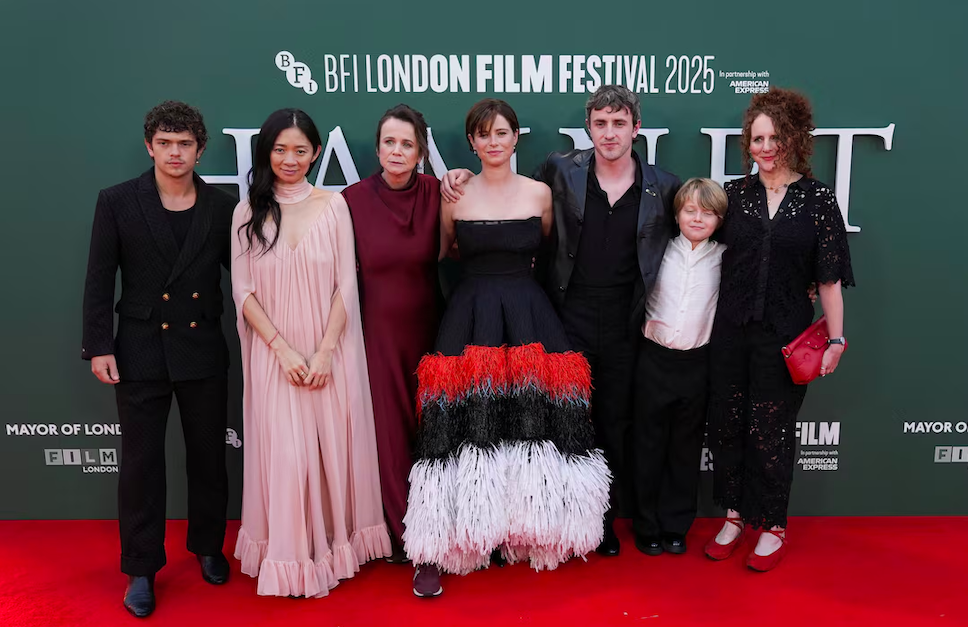
Jessie Buckley delivers a remarkable performance as Agnes, while Paul Mescal portrays William with vulnerability and restraint. Their relationship is depicted not as legend but as something fragile, passionate, and deeply human. Supporting performances from Emily Watson and Joe Alwyn add further emotional depth. The film has been widely praised by critics and recognized as one of the standout cinematic works of the year.
Detailed Story Discussion - Spoiler Alert
The film opens with William working as a tutor before becoming transfixed by a young woman practicing falconry. Her name is Agnes, and their connection is immediate. Rumors surround her origins, shaped by her mother’s reputation and Agnes’s deep knowledge of herbal healing, a skill that later becomes both a gift and a burden.

Agnes is closely tied to the natural world. Forests, caves, and animals serve as spiritual spaces where intuition and storytelling merge. When William recounts the myth of Orpheus and Eurydice, it becomes clear that storytelling is the language through which they truly connect. Agnes foresees greatness in William’s future, alongside devastating loss.
Their relationship leads to marriage and parenthood despite resistance from their families. As William grows increasingly restless, Agnes recognizes that his path lies beyond Stratford. His departure for London creates emotional and physical distance, while Agnes endures childbirth, motherhood, and isolation.
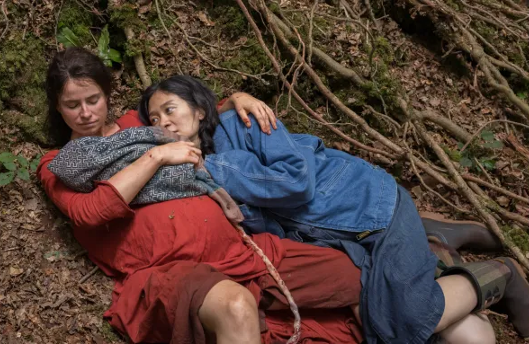
The birth of twins, Hamnet and Judith, marks a turning point. Their bond is portrayed with extraordinary tenderness. When illness strikes, the film allows grief to arrive quietly rather than sensationally. Hamnet’s death becomes the emotional center of the story, unraveling Agnes’s belief in foresight and placing unbearable strain on the marriage.
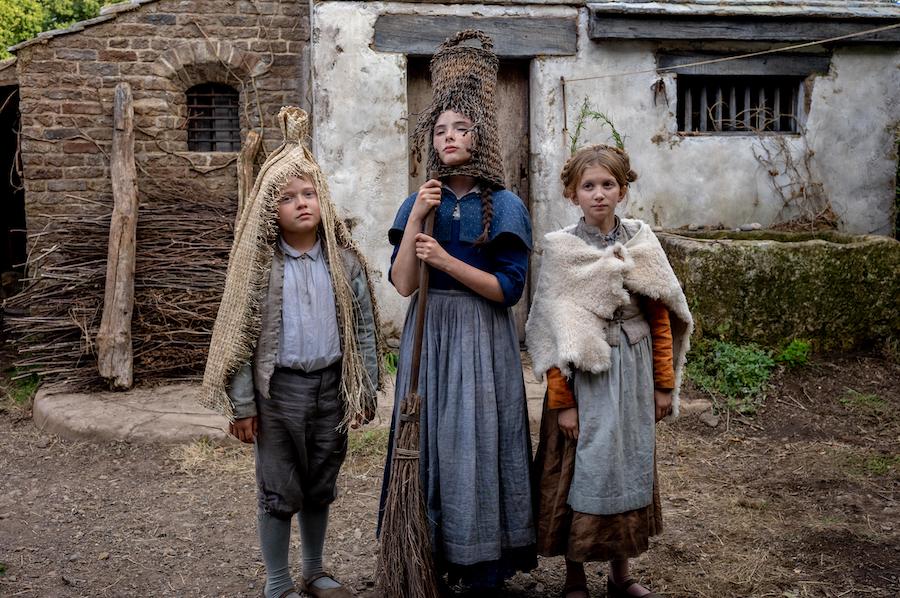
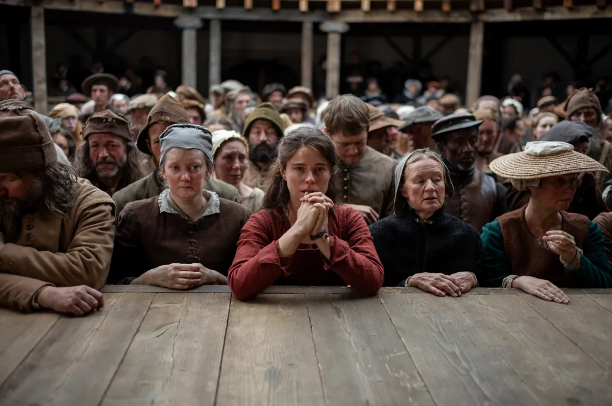
William channels his grief into writing, shaping what will later become Hamlet. When Agnes attends the play’s performance, she is initially outraged, feeling her son’s memory has been violated. Gradually, she understands the work as an act of remembrance rather than exploitation. In the film’s most transcendent sequence, memory, spirit, and theater merge, allowing Agnes a moment of release and healing.
A Magical Touch
In addition to adapting Maggie O’Farrell’s novel, the film draws deeply from ancient literary and spiritual sources. One of its most evocative elements is the repeated use of the Old English Nine Herbs Charm, an alliterative healing spell originating in Anglo-Saxon England. This text, rooted in early English language and ritual, reinforces the film’s connection between words, nature, and survival.
The charm appears throughout the film not as spectacle, but as a living form of language, reflecting how people once understood illness, loss, and healing through poetry and belief. The film incorporates passages from respected scholarly translations by Joseph S. Hopkins and Stephen Pollington, grounding the mystical atmosphere in genuine literary history rather than invention.
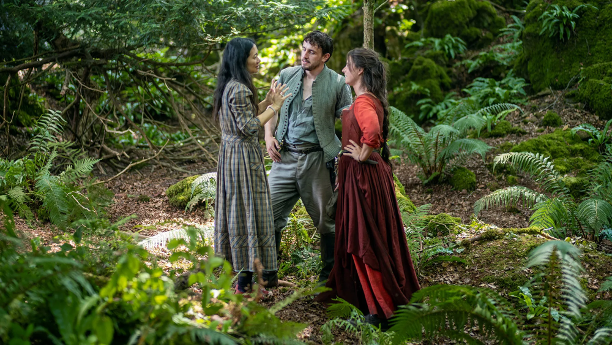
What makes this choice especially meaningful is how naturally it blends into the emotional world of the story. The spell echoes Agnes’s herbal knowledge and intuitive understanding of life and death, while also mirroring Shakespeare’s relationship with language as something powerful enough to comfort, transform, and endure.
Visually, this literary magic is supported by luminous yet restrained cinematography that allows forests, interiors, and faces to breathe. The score by Max Richter moves gently between sorrow and grace, enhancing the film’s spiritual undercurrent without overpowering it.
Bessy’s Final Thoughts
This is a film meant to be experienced in a movie theater for its full emotional impact. You are transported to another time while stepping into a world that feels both real and magical. You will be filled with love for life, followed by deep sadness. This is a true love story, and it is impossible not to be moved.
To be or not to be is no longer an abstract question. It becomes a lived experience. And when one chooses to be, what greater act is there than to create something immortal, as Shakespeare did.

I welcome feedback and thoughts from my readers.
You can reach me at [email protected]
Film Reviewer, Şalom Newspaper